
Apache Roller CVE-2026-129448: Exploited RCE, Who Is Affected and How to Fix It
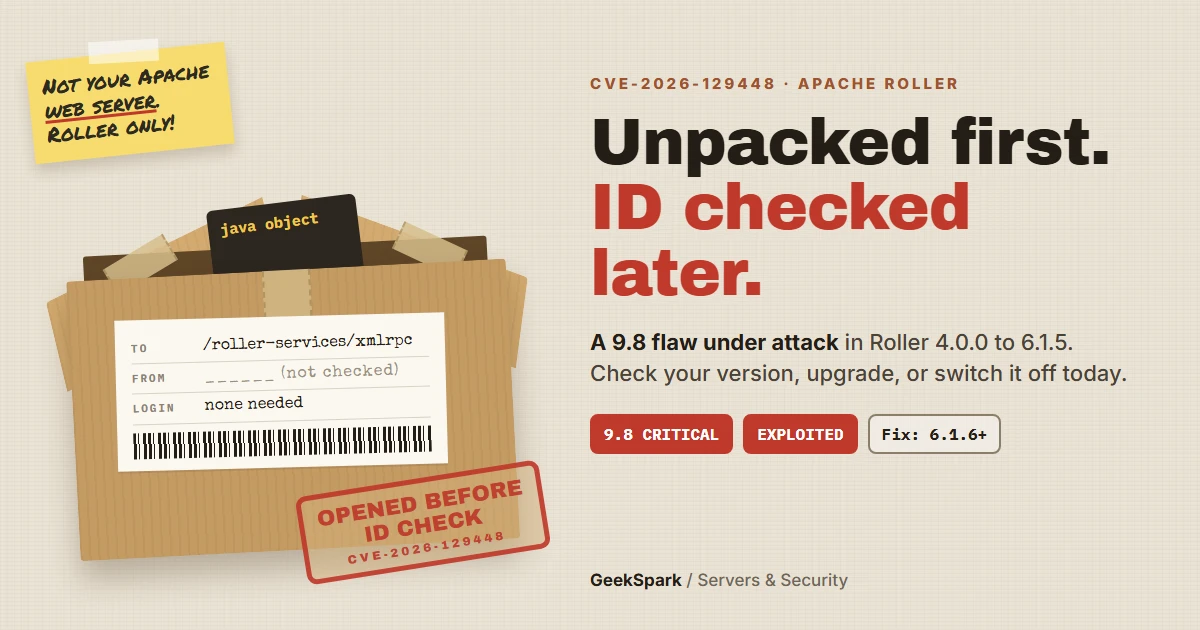
On November 17, the Apache Software Foundation sent out a short warning about CVE-2026-129448, a flaw in Apache Roller, its Java blog server. The advisory carried a line you rarely see from Apache: "This issue is being actively exploited."
The bug is rated 9.8 out of 10. Anyone who can reach a Roller site over the internet can send one crafted request and run their own code on the server. They don't need an account or a password. Three days later, CISA added it to its list of vulnerabilities that attackers are using, and gave US federal agencies until November 23 to deal with it.
The fix has been out since September. The trouble is that many people didn't know they needed it. This guide explains what's broken in plain English, how to tell if your Roller is affected, how to fix it or block it today, and why your Apache web server isn't part of this one.
Last checked: November 24, 2026.
The short version
| What it is | Unauthenticated remote code execution through Roller's XML-RPC endpoint |
| Severity | 9.8 out of 10 (CVSS 3.1), Critical |
| Attacked yet? | Yes. Apache says it's actively exploited, and it's on CISA's exploited list since November 20, 2026 |
| Affected | Apache Roller 4.0.0 through 6.1.5 |
| Fixed in | Roller 6.1.6 or later. The current release is 6.1.7 |
| Workaround | Switch off XML-RPC extensions in web.xml, or remove the XML-RPC servlet mapping, then restart |
| Not affected | The Apache HTTP Server (httpd), Apache Tomcat itself, and anything that isn't Roller |
What is Apache Roller?
Apache Roller is open-source software for running blogs. Dave Johnson wrote it in 2002, and it later became an Apache project. One Roller install can host many blogs and many writers, which made it popular for company blogs. Sun Microsystems chose it for its employee blogs, and IBM used it for its developerWorks blogs.
Roller is written in Java and runs inside a Java web server such as Apache Tomcat. It's a niche product today. But old company blogs have a habit of running for years after everyone forgets about them, and those are exactly the servers that miss updates.
What is CVE-2026-129448, in plain English?
Roller has a feature called XML-RPC. It lets desktop blog editors talk to your blog, so you can write a post in an app and publish it without opening the website. It lives at the address /roller-services/xmlrpc on every Roller site.
XML-RPC requests arrive as text, and Roller turns that text back into Java objects. That step is called deserialization. The library Roller uses for XML-RPC can also accept "vendor extension" types, including whole Java objects packed into the request.
Here's the mistake. Roller unpacked those objects before checking who sent them. Think of a mailroom that opens every parcel before looking at the sender's name. A booby-trapped Java object can run code the moment it's unpacked, so the login check comes too late.
Apache's advisory puts it in one line: the endpoint "accepts vendor extension types and deserializes them before authenticating the requester."
We checked Roller's own source code to see how widespread this is. The setting that allows those extension types, enabledForExtensions, is switched on in the default configuration of every release we looked at: 5.2.0, 6.0.0, 6.1.2 and 6.1.5. In 6.1.7 it's switched off, with a note that Roller never needed it. In other words, a standard install was exposed out of the box.
Why there are two CVE numbers
This part confuses people, so here's the timeline:
- September 24, 2026: Apache released Roller 6.1.6, which switched the extension types off.
- September 25: Apache announced the bug as CVE-2026-82384. It listed only Roller 6.1.5 as affected.
- November 11: Roller 6.1.7 came out with 15 more security fixes.
- November 17: Apache published CVE-2026-129448 for the same flaw in older versions, 4.0.0 through 6.1.4, and said it was being exploited.
- November 20: CISA added CVE-2026-129448 to its Known Exploited Vulnerabilities catalog.
So if you read the September advisory, saw "6.1.5 only" and relaxed because you run 6.1.3, you were exposed the whole time. Every Roller version from 4.0.0 up to 6.1.5 has this hole.
Apache hasn't said who is attacking or how many servers have been hit. Code that claims to exploit the flaw has also appeared on GitHub, so expect more scanning.
Am I affected? Check your Roller version
You're affected if you run any Roller release from 4.0.0 to 6.1.5. To find your version:
- Look in the version file. In Roller 5.2 and later, the version is in
WEB-INF/classes/roller-version.propertiesinside your Roller folder (for example under Tomcat'swebappsdirectory):
grep ro.version /path/to/tomcat/webapps/roller/WEB-INF/classes/roller-version.properties
- Check what you deployed. The release you downloaded, or the version in your build file, tells you the same thing.
- No version file? Then you're almost certainly on something older than 5.2, which is affected.
If the answer is 6.1.6 or 6.1.7, you're covered for this bug.
How to fix it
Upgrade to Roller 6.1.7. Apache's advice is "6.1.6 or later", and Roller only patches its current release line. Version 6.1.7 also fixes 15 more security issues, including another deserialization bug in how Roller reads weblog ping responses (CVE-2026-123374).
Before you upgrade a live blog, read the release notes. A few changes can trip you up:
- 6.1.6 removes Trackback support and retires WSSE login for AtomPub. If your site is set to use WSSE, Roller now refuses to start until you change that setting.
- A fresh install in 6.1.6 asks for a one-time setup token, printed in the server log.
- 6.1.7 switches the Planet feed aggregator off by default. Turn it back on with
planet.aggregator.enabled=trueif you use it. - 6.1.7 only accepts data-changing actions as POST requests. Anything that sends them as a plain link now gets "405 Method Not Allowed".
Take a backup of the database and the Roller folder first. Then test the upgrade on a copy if you can.
Can't upgrade today? Block it now
Apache gives two stopgaps. Pick one, then restart Roller:
- Switch off the extension types. Open
WEB-INF/web.xml, find theXmlRpcServletsection, and changeenabledForExtensionstofalse:
<init-param>
    <param-name>enabledForExtensions</param-name>
    <param-value>false</param-value>
</init-param>
- Remove the XML-RPC endpoint entirely. Delete the servlet mapping for
/roller-services/xmlrpcin the same file. Desktop blog editors will stop working, but most people don't use them any more.
Don't rely on the admin screen. Roller has an option to switch XML-RPC off in its settings. On affected versions that doesn't help, because the request is unpacked before Roller even checks that setting.
You can also block the path in front of Roller. If Roller sits behind a reverse proxy or a web application firewall, refuse requests to /roller-services/xmlrpc from the internet. Treat that as extra cover, not a fix.
How to check whether someone already got in
Patching closes the hole. It doesn't remove anyone who used it before you patched. Apache hasn't published any signs to look for, so start with the basics:
- Read your access logs for
POSTrequests to/roller-services/xmlrpc. If nobody on your team uses a desktop blog editor, every one of those requests is suspicious. - Look for new files in Tomcat's
webappsfolder and in Roller's upload directories, especially.jspfiles you didn't put there. - Check for odd processes started by the user that runs Tomcat, such as shells, download tools or crypto miners.
- Review Roller's user list for admin accounts you don't recognise.
If you find anything, treat the whole server as compromised. Rebuild it from a clean copy, restore the blog from a backup taken before the attack, and change every password and key that server could see.
Is my Apache web server affected?
No. "Apache" is a foundation with hundreds of projects. Roller is one of them. The Apache HTTP Server (httpd), the web server most people mean when they say "Apache", is a separate program and isn't affected by CVE-2026-129448. Tomcat isn't affected either. Roller is an app that runs on top of it.
The Apache web server had its own critical bug this month, though. CVE-2026-119618 in its HTTP/2 module was fixed in version 2.4.71 on November 11. If you run Apache httpd, read our guide to the Apache HTTP/2 flaw. Ubuntu and Debian often fix bugs without changing the version number, so an older-looking version can still be patched.
A busy month for Java and server bugs
Roller joins a long list this autumn. Java apps had Java4Shell, and VMware admins are still cleaning up after the vCenter zero-day. The pattern is the same each time: the attackers find old software nobody is watching. If you run your own server, our new Linux server checklist covers the basics that make these break-ins harder.
Quick answers
What is CVE-2026-129448? A critical flaw in Apache Roller's XML-RPC endpoint. It lets an attacker with no login run code on the server by sending one crafted request. It's rated 9.8 (CVSS 3.1).
Is CVE-2026-129448 being exploited? Yes. Apache's November 17 advisory says it's actively exploited, and CISA added it to its Known Exploited Vulnerabilities catalog on November 20, 2026.
Which Apache Roller versions are affected? Versions 4.0.0 through 6.1.5. Version 6.1.5 was covered by the same bug under CVE-2026-82384.
Which version fixes it? Roller 6.1.6 and later. Upgrade to 6.1.7, the current release, which fixes more issues too.
What's the difference between CVE-2026-129448 and CVE-2026-82384? They're the same bug. CVE-2026-82384, from September, listed only Roller 6.1.5. CVE-2026-129448, from November, covers the older versions.
Does turning off XML-RPC in Roller's settings protect me?
No. On affected versions, Roller unpacks the request before it checks that setting. Use the web.xml workaround or upgrade.
Is the Apache HTTP Server affected? No. Only Apache Roller is affected. The Apache web server had a separate critical HTTP/2 bug fixed in 2.4.71.
Is Apache Tomcat affected? No. Tomcat is the Java server Roller often runs on. The flaw is in Roller's code, not Tomcat's.
Is there a public exploit? Code that claims to exploit it is on GitHub. Apache and CISA say real attacks are already happening, so don't wait for more.
Check your version, upgrade to 6.1.7, and look through your logs. If the blog has no owner any more, this is a good week to switch it off.
Sources
The facts in this article were checked against these sources.
- Apache advisory on oss-security: CVE-2026-129448, Apache Roller unauthenticated deserialization (November 17, 2026) openwall.com
- CVE Record: CVE-2026-129448 cve.org
- CVE Record: CVE-2026-82384 (Roller 6.1.5) cve.org
- Apache Roller security advisories roller.apache.org
- Apache Roller 6.1.7 release notes (CHANGES.md) github.com
- Apache Roller downloads roller.apache.org
- CISA Known Exploited Vulnerabilities catalog: CVE-2026-129448 cisa.gov
- Apache Roller source: XML-RPC servlet settings in web.xml (6.1.7) github.com
- BleepingComputer: Apache warns of Roller RCE vulnerability exploited in attacks bleepingcomputer.com
- The Hacker News: Critical Apache Roller RCE flaw under active exploitation thehackernews.com
- Apache HTTP Server 2.4 vulnerabilities httpd.apache.org