
PHP Security Update November 2026: 17 Fixes to Patch Now, Plus What's New in PHP 8.6
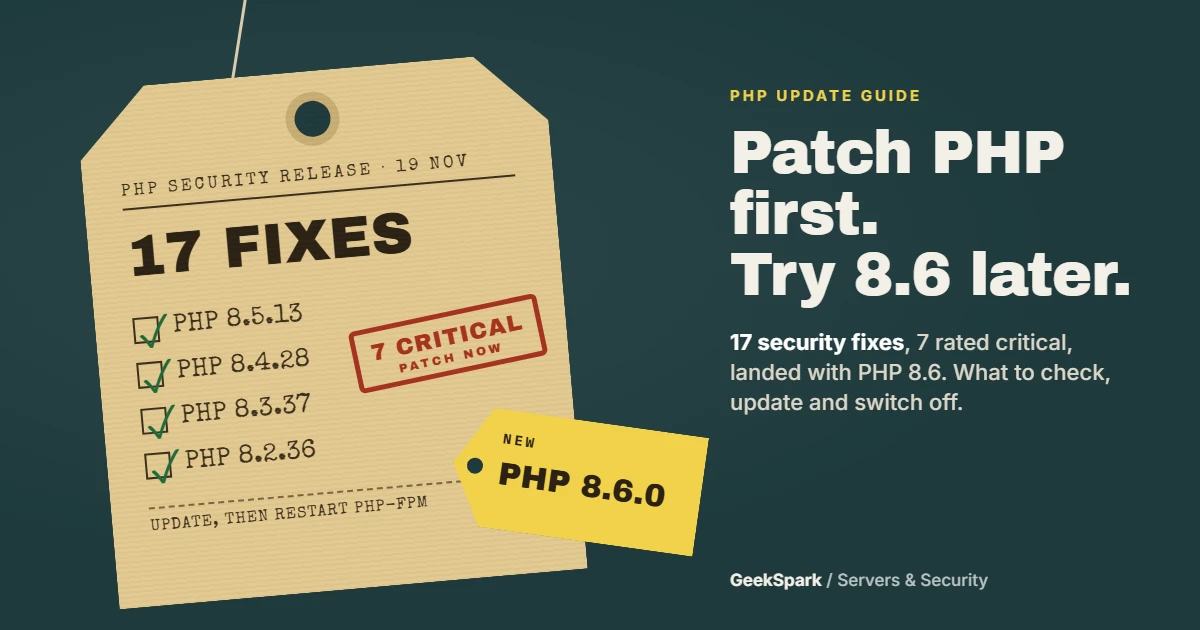
November 19 was a big day for PHP. In one afternoon, the PHP team shipped PHP 8.6.0, the next major version of the language, and security updates for every supported branch: 8.5.13, 8.4.28, 8.3.37 and 8.2.36.
The new features can wait. The security updates can't. They fix 17 vulnerabilities, and PHP rates seven of them critical. Several can lead to running code on your server, and one lets a single crafted request slip past nginx or Apache and talk to PHP-FPM directly.
If you run WordPress, Laravel, Magento or any PHP script, this guide shows you what was fixed in plain words, how to check your server properly (the version number can fool you), how to update, and what to switch off if you can't patch today. Then we'll look at what's new in PHP 8.6 and whether you should move to it yet.
Last checked: November 21, 2026.
The short version
| If you run | Update to | Good to know |
|---|---|---|
| PHP 8.5 | 8.5.13 | Two extra critical fixes that only affect 8.5 |
| PHP 8.4 | 8.4.28 | Also has about 150 ordinary bug fixes |
| PHP 8.3 | 8.3.37 | Security fixes only |
| PHP 8.2 | 8.2.36 | Last few weeks of support: it ends on December 31, 2026 |
| PHP 8.1 or older | A supported version | No fixes from PHP; some distros backport them |
| Ubuntu or Debian packages | Your distro's security update | The version number may not change (see below) |
After updating, restart PHP-FPM (or Apache, if you use mod_php). Running workers keep the old code in memory until they stop.
Skipped October's update? Then this one is even more urgent. The October release fixed the PHP2Shell bugs, and CISA added both of them to its list of vulnerabilities attacked in the wild on October 26. Installing this month's release fixes those too.
What came out on November 19?
Two separate things, released together:
- Security releases for the versions you already run. PHP announced them a day in advance as "critical", noting that the critical issues need either non-default settings or uncommon setups. That's comforting, but "uncommon" covers more servers than you'd think, as you'll see below.
- PHP 8.6.0, a new major version with partial function application, a
Durationclass,clamp()and more. It's a feature release; you don't need it to be safe.
PHP 8.5 and 8.4 also got a long list of ordinary bug fixes, about 150 each. PHP 8.3 and 8.2 are in security-only mode, so they got just the security fixes.
The 17 security fixes, in plain English
Here are the ones rated critical or high. "Worker" means the PHP process that runs your site.
| CVE | What goes wrong | Rating | Branches |
|---|---|---|---|
| CVE-2026-129289 | PHP-FPM request smuggling: a hidden second request reaches PHP | Critical | All |
| CVE-2026-115560 | Session upload progress mixes two data formats, which can lead to code execution | Critical | All |
| CVE-2026-126714 | A half-written session file can lead to code execution | Critical | All |
| CVE-2026-129496 | Timezone cache used after it's freed, which can lead to code execution | Critical | All |
| CVE-2026-129481 | Memory used after it's freed when session cleanup is interrupted | Critical | 8.3 to 8.5 |
| CVE-2026-129474 | Memory used after it's freed in error backtraces, which can lead to code execution | Critical | 8.5 only |
| CVE-2026-129182 | Another stale error backtrace bug, left over from October's fix | Critical | 8.5 only |
| CVE-2026-129291 | PHP-FPM bug that can turn a worker into root | High | All |
| CVE-2026-127960 | Slow-header attack can freeze workers that fetch URLs | High | All |
| CVE-2026-128064 | HTTPS:// written in capitals is sent without encryption |
High | All |
| CVE-2026-128090 | Signed Phar archives can be swapped for unsigned ones | High | All |
The other six are rated medium. They cover PHP-CGI, an XSS bug in the PHP-FPM status page, two SOAP bugs, DOM serialization and URI handling.
Here are the ones most likely to matter to you.
1. Request smuggling in PHP-FPM (CVE-2026-129289)
nginx and Apache talk to PHP-FPM over a protocol called FastCGI. To save time, they can keep that connection open and send many requests down it.
PHP was supposed to throw away any part of a request body your app didn't read. It skipped that step if the app had merely opened php://input, and many frameworks do that early, before routing. A malformed upload could then leave bytes behind that PHP-FPM read as a brand-new request. Nobody had checked or approved it.
That forged request can pick any PHP file on the server, fake the visitor's IP address, and switch on settings that run the attacker's own code. It works with a single request: no memory tricks, no luck needed.
You're exposed only if your web server reuses FastCGI connections. That means fastcgi_keep_conn on in nginx, enablereuse=on in Apache's mod_proxy_fcgi, HAProxy keeping backend connections open, or LiteSpeed's LSAPI. Standard nginx and Apache setups close the connection after each request, and PHP says they aren't affected by the attack it demonstrated.
2. The session bugs (CVE-2026-115560, CVE-2026-126714, CVE-2026-129481)
PHP stores logged-in users in sessions, usually as small files on disk. Three of the critical bugs live here.
- Upload progress (115560). This is the bug PHP warned about in October. A feature that tracks file-upload progress could write session data in one format and read it back in another, which can let an attacker plant objects. The fix turns upload progress off by default. If your
php.initurns it on explicitly, that setting still wins. - Half-written session files (126714). If saving a session was cut off halfway, the file could keep the end of the old data stuck to the start of the new data. Carefully arranged, that mix can be read back as attacker-controlled objects. This affects PHP's default file-based sessions and goes back to PHP 4.1.
- Interrupted session cleanup (129481). A crash during session shutdown could leave a pointer to freed memory that the next visitor's request trips over.
For the first two, the attacker needs a usable "gadget": a class already in your code that does something dangerous when it's unpacked. PHP's own report mentions working examples using the popular Guzzle and Monolog libraries, which are in a huge number of projects.
3. PHP 8.5 error backtraces (CVE-2026-129474, CVE-2026-129182)
PHP 8.5 added a handy feature: fatal errors now come with a backtrace that lists every function call, including its arguments. When a request hits the memory limit at just the wrong moment, PHP can read leftover memory as if it were real arguments. PHP confirmed remote code execution on 8.5, and it names Laravel facades and Magento as code paths that reach the risky kind of call. That doesn't mean a full Laravel or Magento site has been shown to be exploitable.
Most production servers already block the demonstrated attack. PHP's recommended production php.ini sets zend.exception_ignore_args=1, which keeps arguments out of backtraces.
4. Root through PHP-FPM (CVE-2026-129291)
Someone who can already run PHP code on your server, for example through a hacked plugin, could use this bug to take over the FPM master process. That process usually runs as root. It needs catch_workers_output switched on. That's off by default, but it's on in the official PHP Docker images.
5. The quieter ones worth knowing
HTTPS://in capitals (128064).file_get_contents('HTTPS://api.example.com')quietly connected without encryption, because PHP only checked for a lowercase "s". Redirects could trigger it too.- Timezone cache (129496). A startup warning written to PHP's error log file could leave a dangling pointer that an early request can abuse. It's real but needs specific logging conditions.
- Phar signatures (128090). An attacker who can swap a signed Phar archive could relabel it as "SHA-256" and PHP would never check the key.
Am I affected? Check the right way
Start with:
php -v
If it shows 8.5.13, 8.4.28, 8.3.37, 8.2.36 or 8.6.0, you're on a fixed release. If it shows something older, check the next part before you panic.
Ubuntu and Debian rarely change the PHP version in an update. They copy the fixes into the version they already ship. This is called backporting. A fully patched Ubuntu 24.04 still says PHP 8.3.6.
So look inside your installed package instead. On Ubuntu and Debian:
zcat /usr/share/doc/php*-common/changelog.Debian.gz | grep -m1 CVE-2026-129289
If that prints a line, the fixes are in. If it prints nothing, you aren't patched yet.
We checked the Ubuntu and Debian package changelogs and trackers on November 21. These packages contain the fixes:
| System | Fixed package |
|---|---|
| Ubuntu 24.04 LTS | php8.3 8.3.6-0ubuntu0.24.04.14 |
| Ubuntu 22.04 LTS | php8.1 8.1.2-1ubuntu2.29 |
| Debian 13 (trixie) | php8.4 8.4.28-1~deb13u1 |
| Debian 12 (bookworm) | php8.2 8.2.36-1~deb12u1 |
Using Ondřej Surý's PPA (very common on Ubuntu servers that need a newer PHP)? It uses PHP's own version numbers, so php -v tells the truth. The fixed builds look like 8.3.37-2+ubuntu24.04.1+deb.sury.org+1.
Check the PHP your website uses, not just the command line. Servers can have several PHP versions side by side. List every PHP-FPM service with:
systemctl list-units --type=service | grep -i fpm
Step 1: Install the update
Ubuntu and Debian (distro packages or the Ondřej PPA):
sudo apt update
apt list --upgradable 2>/dev/null | grep -i php
sudo apt upgrade
The middle line shows which PHP packages are waiting, so you know the update is really there.
Red Hat, AlmaLinux, Rocky Linux: run sudo dnf update 'php*'. If your vendor hasn't published the update yet, use the workarounds below in the meantime.
Docker: move to php:8.5.13, php:8.4.28, php:8.3.37 or php:8.2.36 (the -fpm and -apache variants are on Docker Hub) and rebuild your image. Restarting an old container changes nothing. Because the official images switch on catch_workers_output, this update matters even more for containers.
cPanel, Plesk and other control panels: update through the panel's PHP manager (EasyApache, Plesk Updates and so on). Check every PHP version your sites use.
Shared hosting: your host handles it. Ask support whether PHP has been updated to the November 19 releases.
Step 2: Restart PHP
sudo systemctl restart php8.3-fpm
Use your own version number, and repeat it for each FPM service from the list above. If you run PHP inside Apache (mod_php), restart Apache instead. Then load a page and confirm the site works.
Can't update today? Turn these off
These stopgaps come from PHP's own advisories. Each one covers one bug, so they are no replacement for the update.
| To block | Do this |
|---|---|
| Request smuggling (129289) | Leave fastcgi_keep_conn off in nginx and enablereuse off in Apache |
| Upload progress (115560) | Set session.upload_progress.enabled = 0 in php.ini and every FPM pool |
| PHP 8.5 backtraces (129474, 129182) | Set zend.exception_ignore_args = 1, or fatal_error_backtraces = 0 |
| FPM root bug (129291) | Set catch_workers_output = no in your FPM pools |
HTTPS:// in capitals (128064) |
Write URL schemes in lowercase and validate redirect targets |
To see where your server stands, run:
sudo nginx -T 2>/dev/null | grep -n fastcgi_keep_conn
grep -rn "enablereuse" /etc/apache2 /etc/httpd 2>/dev/null
grep -rn "upload_progress.enabled\|exception_ignore_args\|catch_workers_output" /etc/php/
Change settings in php.ini or the FPM pool files, not with ini_set() in your code. PHP warns that's too late for the session bug. Restart PHP after each change.
The bug fixes in 8.5.13 and 8.4.28
Beyond security, PHP 8.5 and 8.4 got about 150 fixes each. A few you might have hit:
- OPcache after an Apache graceful restart could reuse cache files that didn't match, a source of odd errors after reloads.
- JIT crashes and wrong results. Dozens of fixes, including spurious "Too few arguments" errors and a case where a number came back as a wrapped integer instead of a float.
- MySQL: a crash when connecting with an empty password to a MariaDB PAM account.
- JSON:
json_encode()no longer keeps going after a key fails to encode. - Fibers: a
catchblock could be skipped when fibers switched during an exception. - The optimizer turned
$x = $x - 1onnullinto the wrong operation.
If your app showed odd JIT or OPcache behaviour, this update may quietly fix it.
What's new in PHP 8.6
PHP 8.6.0 is supported with bug fixes until December 31, 2028 and with security fixes until December 31, 2030. The headline features:
- Partial function application. Fill in some arguments now and get back a function that takes the rest, using
?placeholders. For example,array_filter($versions, version_compare(?, '8.6', '>='))replaces a whole arrow function. \Time\Duration. A proper type for timeouts and timings, with nanosecond precision, so you stop guessing whether a number means seconds or microseconds.clamp(). Keeps a value inside a range in one call, in place of the usualmin(max(...))dance.SortDirectionenum. A built-inAscending/Descendingtype that libraries can share, in place ofSORT_ASCintegers or strings.- Readonly property defaults. Readonly properties can finally have a default value, with no constructor needed.
- A polling API (
Io\Poll). Fast I/O monitoring using epoll and kqueue, aimed at event-loop libraries such as ReactPHP and AMPHP.
There's more in PHP's release notes: doc comments on individual parameters, #[\Override] on constants and post-quantum key exchange in Sodium.
Should you upgrade to 8.6 now?
For most production sites, not yet. Patch your current version first. Then test 8.6 on a staging copy once your framework, plugins and hosting say they support it. Major PHP versions always include deprecations and small breaking changes, and the migration guide on php.net lists them.
The exception is PHP 8.2. Its support ends on December 31, 2026, about six weeks away. If you're on 8.2, plan a move now. PHP 8.4 or 8.5 is the safe, well-tested choice today.
Make the next patch automatic
Servers with automatic security updates get Ubuntu and Debian PHP fixes without anyone logging in. You still need to restart PHP-FPM afterwards, or reboot on a schedule. Our 30-minute Linux VPS security checklist sets up automatic updates along with SSH keys and a firewall.
It's been a heavy month for server patches. This release landed in the same week as nginx2root and Java4Shell, and a month after PHP2Shell. If one server runs all of these, update them together and restart once.
Quick answers
What is the latest PHP version? PHP 8.6.0, released November 19, 2026. The latest security releases for older branches are 8.5.13, 8.4.28, 8.3.37 and 8.2.36.
Is the November 2026 PHP update urgent? Yes. It fixes 17 vulnerabilities, seven rated critical, and some can lead to running code on your server. Many need specific settings, but you'd have to check every one of them to be sure, and updating is quicker.
What is CVE-2026-129289? A request smuggling flaw in PHP-FPM. When nginx or Apache reuses FastCGI connections, leftover bytes from a request body can be read as a second, forged request that can run code. It's fixed in 8.5.13, 8.4.28, 8.3.37 and 8.2.36.
Is CVE-2026-115560 fixed now? Yes. This is the session upload progress bug PHP warned about in October. The November releases fix it and turn upload progress off by default.
My Ubuntu 24.04 server says PHP 8.3.6. Am I vulnerable?
Not if the package is 8.3.6-0ubuntu0.24.04.14 or later. Check with zcat /usr/share/doc/php*-common/changelog.Debian.gz | grep CVE-2026-129289.
Will updating break my WordPress or Laravel site? Very unlikely. These are patch releases within your current version. The one setting that changes is session upload progress, now off by default, and few sites use it. Upgrading to PHP 8.6 is a different matter and needs testing.
When does PHP 8.2 reach end of life? December 31, 2026. After that, PHP publishes no more security fixes for it.
Do I need PHP 8.6 to be safe? No. The security fixes are in 8.5.13, 8.4.28, 8.3.37 and 8.2.36. PHP 8.6 is about new features.
One check, one update, one restart. If you look after a PHP server, especially one that skipped October's update, do it today.
Sources
The facts in this article were checked against these sources.
- PHP: PHP 8.6.0 released and November 19 security releases php.net
- PHP 8 ChangeLog (8.5.13, 8.4.28, 8.3.37, 8.2.36) php.net
- PHP 8.6 release page php.net
- PHP supported versions php.net
- GHSA-qc49-hpvq-g2w6: PHP-FPM request smuggling (CVE-2026-129289) github.com
- GHSA-658j-r8rw-q6mx: Session serializer mismatch (CVE-2026-115560) github.com
- GHSA-8mjj-2r7p-4hg2: Use-after-free in magic method backtraces (CVE-2026-129474) github.com
- GHSA-jm4m-qfqx-967m: PHP-FPM epoll use-after-free (CVE-2026-129291) github.com
- Ubuntu changelog: php8.3 8.3.6-0ubuntu0.24.04.14 changelogs.ubuntu.com
- Debian security tracker: CVE-2026-129289 security-tracker.debian.org
- CISA Known Exploited Vulnerabilities catalog cisa.gov